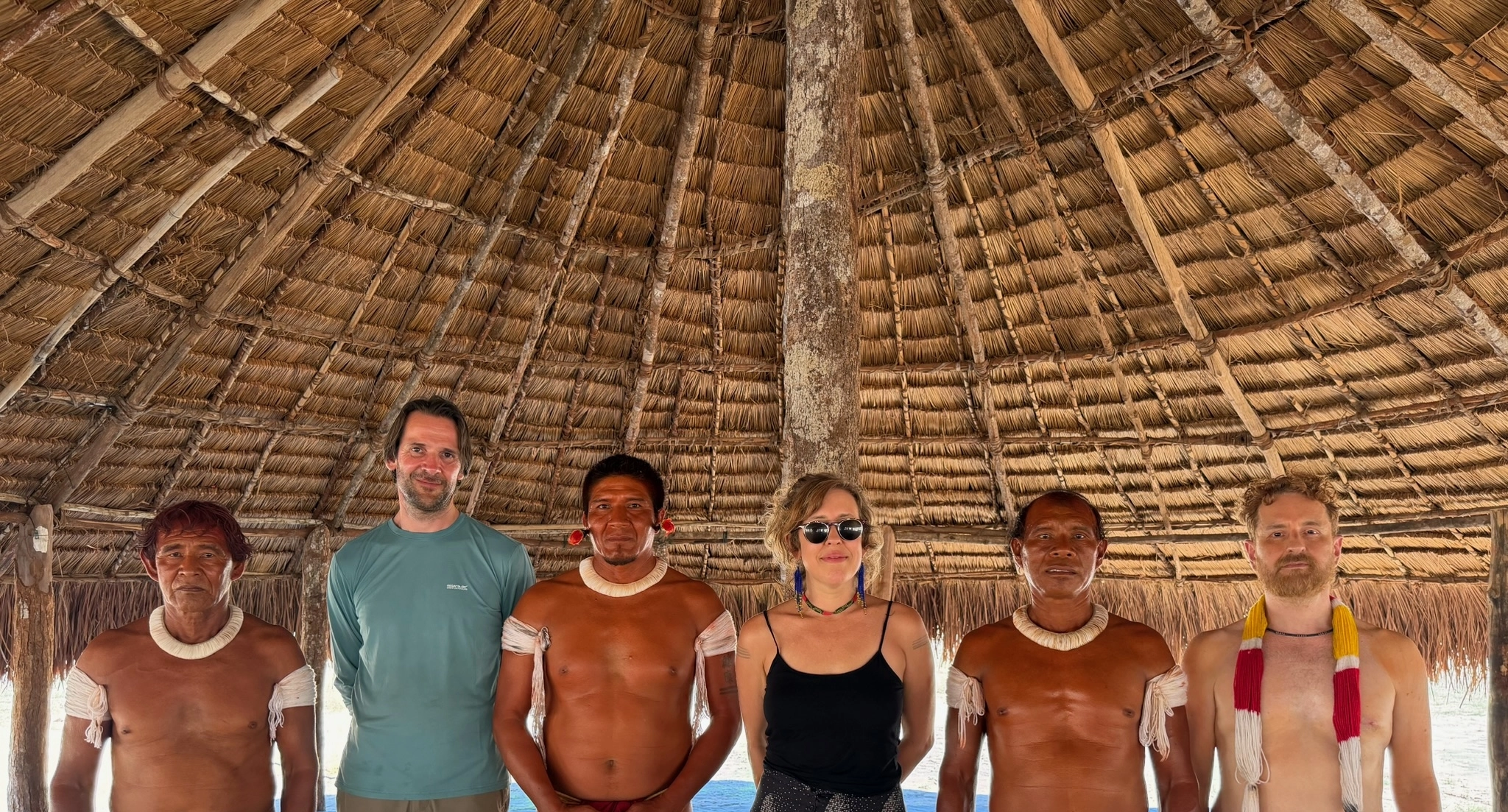
Andreia Duarte is a dramaturg, artistic researcher and founder of Outra Margem, our creative partner for Breath of the Forest. For the past 25 years, Duarte has worked closely with Indigenous peoples. As an artist, curator and researcher, she explores the relationship between art, Indigenous knowledge and Brazil’s colonial history.
How did you first get in touch with NBE, Duda Paiva Company and the Breath of the Forest project?
How did you first get in touch with NBE / DPC and the Breath of the Forest project?
After that, I returned to Brazil. We continued to know each other and follow each other’s work as artists, but each of us followed our own path.
Last year, Duda told me that he had the dream of creating a project with Indigenous peoples in Brazil, in partnership with the Nederlands Blazers Ensemble and the Duda Paiva Company. That was how he began looking for professionals who could be part of this project, and he told me that, in different conversations, several people had told him that he should speak to me. The curious thing is that, at that moment, he had not exactly made the connection between those recommendations and the person he had already known 11 years ago.
When he got in touch with me, I said: “Duda, it’s me. Do you remember me?” And he replied: “Of course, I remember!” From then on, we continued talking and had some meetings to align our thinking and to understand what this proposal for a performance that could engage in dialogue with Indigenous peoples and their knowledge could be.
I thought the idea was wonderful. I already knew Duda’s work and have great respect for him as an artist, dancer, and puppeteer. So I understood that the project could be very interesting, because of the possibility of building a horizontal dialogue with Indigenous peoples, their rights, and their ways of thinking. Also because of the opportunity to be there as a creator and dramaturg, considering what I understand, experience, and have been working on for years regarding the relationships between art and Indigenous peoples.
It was during this process, through the Duda Paiva Company, that I also met Brandt, the artistic director of the Nederlands Blazers Ensemble, and the project that later became Breath of the Forest.
Can you elaborate on the role of Outra Margem in the production?
Outra Margem is a platform for thought and artistic creation deeply connected to my practice and research as an artist, curator, and director. Throughout my career, I have been developing practices that seek to understand how non-colonial epistemologies, such as the knowledge of Indigenous peoples, beyond the cultural, cosmological, and historical specificities of each people, can bring other parameters of knowledge that create friction, tension, and reveal other ways of existing than those predominant in the Western capitalist world.
This research takes place through different artistic, educational, and reflective fields: theatre, curatorship, literature, festivals, academic production, exhibitions. These are aesthetic and political actions that seek to reflect and experiment, in thought and in practice, on how we can be in the world in a less destructive way and more connected to social justice, to combating colonial heritage, and to the possibility of continuity of life for everyone.
Indigenous peoples have been teaching us for a long time other forms of relating to life: through a way of living that is more collective and deeply connected to the territory; with this understanding at its centre: that we are not owners of the land, but belong to the land. This is an understanding of human health and of maintaining the health of the planet.
It is from these concepts that Outra Margem works. And from the possibility of bringing this knowledge into dialogue with society, always doing things together with Indigenous peoples, but also alongside artists and intellectuals who are thinking and creating from different perspectives of the Global South. For me, “doing together” is fundamental, because it places us before differences — differences in values, ways of doing, and ways of understanding the world — and invites us to open ourselves to these differences and to learn other ways of being in the world.
Within Breath of the Forest, Outra Margem acts as a kind of intellectual and practical consultancy, seeking to ensure and value dialogue with Indigenous thought, their participation and, in this case, specifically, the Kamayurá body and presence in the project.
It is also a role of Outra Margem to value the main forms of knowledge being brought by the Kamayurá and to develop these reflections from an ethical and political perspective, considering Brazil’s colonial history and the histories of confrontation, resistance, and survival of Indigenous peoples in the face of coloniality and capitalism.
In this sense, I see Outra Margem as a mediator. A mediation that seeks to transform the theatrical action through these concepts and to ensure that the work is not limited to ensuring the presence of Indigenous artists on stage. It is fundamental that there is no appropriation of their knowledge, but that there is a true dialogue with them — a dialogue that requires ethics, respect, openness, and horizontality.
This mediation also takes place within the creative process itself: how do we work with Indigenous peoples within languages such as theatre, dance, music, and the stage? How can we engage in dialogue? What places can we create together? How can we be together, doing things together, bringing voice, body, and word?
Therefore, Outra Margem’s work takes place both in the field of reflection on Indigenous peoples — not only from a cultural perspective, but also from an ethical, political, and epistemological perspective — and in dramaturgical creation and the construction of the meaning of the performance.
For me, dramaturgy is precisely the meaning that the performance constructs for the audience. Therefore, when I take on the role of dramaturg alongside Duda Paiva, I think about ensuring that fundamental concepts — about life, knowledge, the relationship with difference, historical processes, territory, and ecology — are present when these issues enter the theatrical, dramaturgical, playful, and artistic field.
The aim is for these elements to be firmly established in the construction of the work itself, producing an artistically powerful message and, at the same time, one that values the broad and ecological knowledge of Indigenous peoples for the well-being of the world.
In your opinion, what is the most important aspect of the production?
In my opinion, one of the most important aspects of the production is the participation of Indigenous people in a theatre, alongside a symphonic wind orchestra and a dance company in Amsterdam. It is about bringing Indigenous bodies, people, and artists — in this case, Kamayurá musicians — to live this experience, occupy this space, present their culture, their thought, their music, and their songs, but also to meet other people and allow other people to meet them. It is about creating a place where they can bring forward issues that are especially important to the life of their people.
But there is also something very important: this movement of returning to the community that we are all making. When Outra Margem establishes this connection between the Duda Paiva Company, the Nederlands Blazers Ensemble, and the Kamayurá, it is not simply a matter of inviting the Kamayurá to participate in the performance. We invited them to be with us in the artistic field and, at the same time, proposed to carry out a contribution to the community itself.
In other words, we not only recognise them, but the project also remunerates their copyright and image rights, and we are also trying to contribute to a process that they themselves are seeking: the strengthening of the traditional knowledge of their culture. In this case, through teaching songs and instruments, especially flutes, within the community itself, and also through the production of materials, such as books, that can record their stories, ancestral memories, and aspects of the cosmology of the Kamayurá people.
I think we also have a great opportunity because we are very different people and institutions. We have a symphonic wind orchestra; a dance and puppetry company directed by an artist, Duda Paiva, who is very attentive to contemporary issues related to ecology; a platform directed by a Brazilian artist, curator, and researcher, Andreia Duarte, who has worked for 25 years in a direct relationship with Indigenous peoples and in combating colonial heritage; and an Indigenous community, the Kamayurá, who inhabit the middle of Brazil, within the Brazilian Amazon rainforest, and who have their own way of living, their own language, and their own
way of understanding the world.
We are, therefore, bringing different ways of thinking about music, art, and artistic modes of production into relation. And these differences are also crossed by the power relations of the art market and by the different forms of cultural production between the Global North and the Global South. For us, as Brazilians and as part of what is called the Global South, this is directly related to questions of coloniality.
Brazil was also colonised by the Netherlands, and this history of colonisation brought profound consequences for all of us: the violence it produced, the definitions of what we understand today as the Western world and what lies outside it, the values we attribute to things, and the relationship with the body, nature, etc.
Therefore, I consider it very important that all these institutions, companies, and people involved in the process are open to experiencing an experience that seeks to engage in dialogue with the knowledge of an Indigenous people — in this case, the Kamayurá. This openness also needs to exist within the creative process and in the production. From executive production and communication to artistic creation, because in this process there is a need for us to be available to listen and, sometimes, to give up our ways of doing things in order to include others who have experienced processes of invisibilisation and injustice throughout the history of the world. It is a process of recognition and action.
And, above all, it is important that this process has a return to the community. It is not simply about “helping” the Kamayurá, but about strengthening what they themselves consider fundamental to the continuity of their existence, such as their music, their instruments, their stories, and their memory.
For me, this possibility of creating a relationship of exchange, recognising the knowledge of an Indigenous community and, at the same time, contributing to the strengthening of this knowledge within the community itself, is one of the most important aspects of the production.
In your opinion, what is the essence of the story?
In my opinion, the essence of the story is to look at the world from a perspective in which we are all nature and in which nature itself has its point of view. Animals, the jaguar, the forest, and the mountains belong to the world and are fundamental to the balance of all the diversity of life, including humanity.
It is fundamental to understand that, when we destroy nature, we are destroying ourselves. But the history of humanity has been demonstrating another path: that of placing humans at the centre of the world. We therefore need to assume that our choices have consequences: climate change, floods, inundations, changes in the seasons, extreme heat, and so many other phenomena are related to the way in which we have exploited the planet.
For me, it is also fundamental to understand that Indigenous peoples are deeply connected to nature. They have inhabited these territories for millennia and continue to exist, resist, and reinvent their ways of living. This does not mean that they are outside the contemporary world. Indigenous peoples also engage with the internet, mobile phones, and all contemporary technologies. They live in the present and, at the same time, remain collectively connected to the land.
This perspective presents us with a more horizontal relationship with nature and allows us to understand other forms of organising life. It is also a critical perspective on the capitalist project of exploiting the planet and people, which produces social and human inequality.
This is a teaching that recognises and values the knowledge of these peoples about the collective, territoriality, the importance of forest life, and different perspectives on the world. Human beings come to occupy a place among animals, mountains, the forest, the planet Earth, and ancestral time.
For me, this is the main message we want to bring to the audience and, especially, to the Dutch audience. This is what the dramaturgy seeks to construct: an experience that makes us recognise our interdependence and think about how we can live in a way that preserves the diversity and continuity of life.
What response would you like to provoke in the audience after experiencing this production?
I would like the performance to broaden the audience’s perspective beyond a cultural perspective on a specific people. I would like it to open up a broader perspective on a supportive ecology in the world and on our social and economic responsibility towards other peoples, towards countries that suffer from the legacy of colonial exploitation, which reverberates to this day, but also towards the planet Earth.
I would like the audience to recognise that there are different ways of living and that this is also a great opportunity for us to move beyond our usual places. More than simply getting to know or admiring Kamayurá culture, which is indeed an incredible culture, I would like the audience to leave the performance with the desire to recognise these differences and to think about how we can build ways of living that are less violent towards others.
There is so much violence and hunger in the world, there are wars, there is deforestation every day, climate change, so, faced with all of this, what can we do?
If the performance opens people’s eyes, provokes this recognition that we are all nature, bringing together all these questions that I am raising here, then I believe that the performance will have fulfilled, poetically, an important part of its role.